Your TAM Slide Says a Billion Dollars. Your Territory Plan Says Something Else.
Territory plans built forward from a billion dollar TAM slide almost always break by the second quarter. This post walks through why the forward method fails and how to size territories backward from the revenue number you actually need to hit.
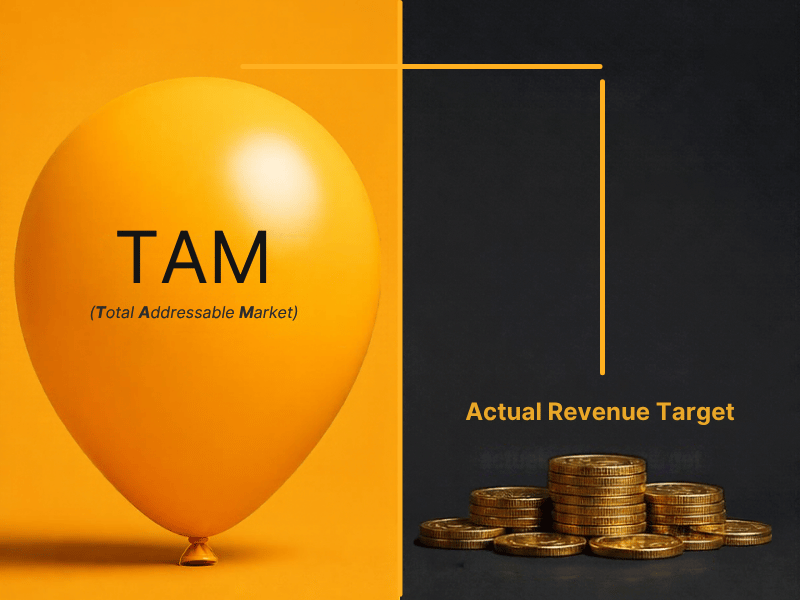
Your TAM slide says a billion dollars. Your territory plan says something else. Only one of those numbers is honest, and it is never the billion.
I keep getting pulled into territory planning conversations that start with an inflated addressable market number and build forward from there. Someone pulls a market sizing report, applies a growth multiplier, and lands on a number big enough to make the board deck look aggressive. Then sales leadership works forward from that number to build coverage plans, quotas, and pipeline targets. It looks great in September. By February it is the reason the whole plan is underwater.
I have sat in enough forecast reviews to know exactly where this breaks, and it breaks the same three ways almost every time.
Why Forward-From-TAM Planning Falls Apart
The first crack shows up in coverage. A TAM slide treats every account in the addressable market as reachable this year. In practice, once you apply real ICP filters, firmographic fit, buying triggers, existing vendor relationships, the reachable list shrinks fast. I worked with a manufacturing software company that had a TAM slide claiming 40,000 target accounts in North America. After filtering for company size, tech stack compatibility, and actual budget authority at the right seniority level, the realistic list was closer to 2,800. Nobody had done that filtering before assigning territories. Reps were handed lists built off the 40,000 number and spent half their quarter calling into accounts that were never going to close.
The second crack is quota math. Quotas get set against a market size that nobody validated against real buying activity in the segment. A billion dollar TAM does not tell you how many of those dollars move in a given quarter, how long the sales cycle runs, or how many of those companies are locked into a competitor for another eighteen months. I have seen quotas set purely by dividing a market size number by headcount, with zero reference to historical win rates or deal velocity in that segment. That is not quota setting, that is arithmetic dressed up as strategy.
The third crack is the one that actually kills the quarter: pipeline targets that look fine on a slide and collapse once reps run out of real accounts to call. This is the one leadership notices last because it takes a full sales cycle to show up. By the time it is visible in the numbers, you have already lost a quarter of selling motion chasing a plan that was never grounded in reality.
What Backward Planning Actually Looks Like
The fix is slower and less exciting than a billion dollar TAM slide, which is exactly why most teams skip it. Start from the revenue number the business actually needs. Work out how many closed deals that requires, based on your real average deal size, not an aspirational one. Then size the account list backward from there.
Here is the sequence I actually run with clients. Say the target is 4 million dollars in new bookings for the year, and average deal size for the segment is 40,000 dollars. That is 100 closed deals. If your historical close rate on qualified opportunities is 25 percent, you need 400 qualified opportunities in the pipeline. If your opportunity-to-lead conversion sits around 20 percent, you need 2,000 qualified leads worked over the year. Now you go find the account list that can realistically produce 2,000 qualified leads, not the account list that makes the TAM slide look impressive.
This method uses numbers you already have sitting in your CRM, assuming the data is clean enough to trust, which is a separate problem worth fixing first. It does not require a market research subscription or an analyst report. It requires someone willing to pull historical close rates, average deal size, and conversion rates by stage, and then do the division.
The Account List Problem Nobody Wants to Solve
Once you have the number of accounts you actually need, the harder question shows up: do that many qualified accounts exist in your addressable market, and are they reachable by the reps you have? This is where I see companies quietly discover their real ceiling. A professional services firm I worked with needed roughly 900 qualified accounts to hit their number. Their actual reachable market, after applying ICP and excluding accounts already locked into multi-year contracts with competitors, was 1,100. That is a workable margin. Another client in a narrower vertical needed 600 and had a real reachable list of 640. That is not a coverage plan, that is a company betting its whole year on near-perfect execution with zero room for a bad quarter.
That second scenario is common, and it usually gets discovered by accident, mid-year, when a rep runs out of accounts to call and asks what to do next. Better to find that ceiling in the planning phase, when you can still adjust deal size targets, expand the ICP intentionally, or add a channel motion, than in Q3 when the only option is a scramble.
Which Way Does Your Planning Actually Run
Most companies think they are planning backward from revenue because that is the number in the headline of the plan. But the headline number and the actual math underneath it are two different things. If nobody can walk you through the chain from revenue target to deal count to opportunity count to account list, the plan was built forward from TAM no matter what slide it opened with.
The honest version of this exercise takes a few hours with a spreadsheet and real historical numbers pulled from your CRM. It is not glamorous work and it will not make the board deck look bigger. It is also the version that survives contact with a real quarter, which is the only version that matters once the year starts.
If your territory plan was built off a TAM slide instead of your own revenue math, that is an easy thing to fix before the next planning cycle starts. Reach out to LangLine Consulting and we can walk through the account math together.