
Your Forecast Is a Guess With a Decimal Point: Fixing Stage Definitions and Slipped Deals
Most B2B forecasts fail not because of bad math, but because nobody agrees on what a pipeline stage actually means. This guide walks through building written exit criteria, a slipped-deal aging report, and a reconciliation routine you can run in HubSpot, Salesforce, or monday CRM starting this month.
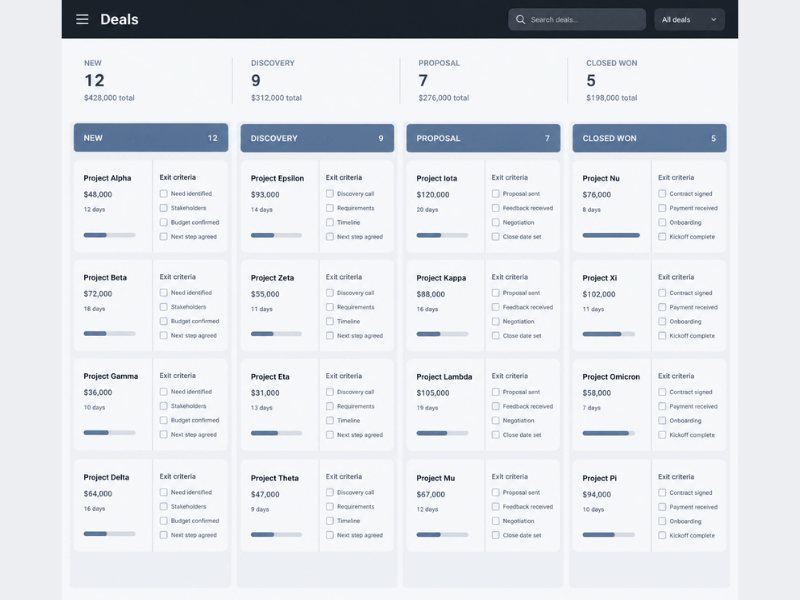
If you asked the two best reps on your team to define what commit means, you would get two different answers, and both would sound confident. That is not a coaching problem. That is a forecast integrity problem, and it is sitting in your CRM right now disguised as a probability percentage.
Most pipeline stages carry a weight nobody can defend. Discovery is 20%, proposal is 60%, negotiation is 80%. Somebody set those numbers years ago, maybe based on a cohort of deals that no longer resembles your current pipeline, and nobody has touched them since. The forecast your leadership reviews every Monday is built on that math. It looks precise. It is not.
Why Weighted Probability Math Breaks Down
The core issue is not the percentages themselves, it is what they are standing in for. A probability weight is supposed to represent the likelihood a deal closes based on where it sits in the process. But if two reps define proposal differently, one sending a formal document and one sending a budgetary estimate after a single call, then the 60% attached to that stage means two different things depending on who owns the deal. Average those together across twenty open opportunities and you get a forecast number that feels authoritative and means almost nothing.
According to B2B Notes and SalesGrowth, this is a widespread pattern: forecasts fail because CRM stages are loosely defined, close dates go stale, and deals that have clearly slipped stay open in the active pipeline view instead of getting flagged. Reported accuracy benchmarks vary by source and industry, but a consistent theme shows up across the coverage, many teams operate in the 70 to 79% accuracy range, while forecasts within roughly 5 to 15% of actual revenue are considered strong. That gap between where most teams sit and what counts as good is not a tooling problem. It is a governance problem, and it is fixable without buying anything.
The fix is not a better algorithm. It is replacing vibes with evidence at every stage gate, then building a report that makes slippage visible instead of letting it hide inside a stale close date.
Step One: Write Exit Criteria for Every Stage, Not Entry Criteria
Most CRM stage definitions describe when a deal enters a stage. That is the wrong half of the problem. What you need is a written, specific description of what has to be true for a deal to leave a stage, with evidence a second person could verify without calling the rep.
For a five to seven stage pipeline, a workable exit criteria set looks like this. Discovery exits when the rep has documented the business pain, the budget range, and the economic buyer by name, not just a contact. Proposal exits when a written document with pricing has been sent and opened, which you can track with HubSpot document tracking or a comparable feature in Salesforce. Negotiation exits when redlines or a signature process has actually started, not when the rep believes the deal is close.
The test for good exit criteria is simple. If a sales manager can look at the deal record and verify the criteria without a conversation, it is specific enough. If verifying it requires asking the rep how they feel about it, rewrite it.
Ownership of these definitions should sit with one person, typically whoever runs RevOps or, at a company without that function, whoever owns the CRM build. Not whoever happened to configure the pipeline view first. Stage definitions that evolve by whoever edits them last are part of why the forecast degrades over time.
Step Two: Build a Slipped-Deal Aging Report Separate From the Main Pipeline
Here is the detail most small teams skip. A deal that has had its close date pushed three times is fundamentally different from a deal hitting its first projected close date, and your main pipeline view treats them identically. Both show up as open, both carry their stage probability, both get counted in the forecast roll-up.
Build a separate report, not a filtered view of the same report, that tracks three fields: how many times the close date has moved, the cumulative number of days it has slipped, and whether a reason code was logged at each move. In HubSpot this means adding a close date change counter via workflow automation and a required dropdown field for slip reason, logged each time, not edited in place. In Salesforce you can build this with a flow that triggers on close date field change and writes to a related history object. monday CRM can handle this with an automation that logs to a separate board on date change.
A deal with two or more slips and no documented reason is not a pipeline deal anymore. It is a liability sitting in your coverage number. Run this report weekly, not monthly, because by the time it shows up in a monthly review the quarter is already compromised.
Step Three: Measure Dollar Variance, Not Just Deal Count
Most sales leaders track forecast accuracy by counting how many deals closed versus how many were forecasted. That tells you about hit rate, not about dollar exposure, and those are not the same risk. One $200,000 deal slipping does more damage to a forecast than five $10,000 deals missing.
Track variance in dollars by month. Compare committed forecast dollars against closed-won dollars at the end of each period, and track the percentage gap over a rolling six months. This is the number that tells you whether your stage definitions and exit criteria are actually working, because if the variance keeps narrowing, your governance is catching the right things. If it stays flat or widens despite tighter stage criteria, the problem is probably with specific reps or specific segments inflating commit, not with the stage framework itself.
Step Four: Run a Weekly Commit and Upside Review That Argues About Evidence, Not Feelings
Most deal review conversations are secretly an argument about what a stage means. A rep says the deal is committed, the manager is skeptical, and the conversation spirals into gut-feel debate because there is no shared standard to point to.
A weekly commit and upside review should run against the exit criteria document, not against rep confidence. The question is never do you feel good about this deal. The question is has the specific evidence required for this stage been logged in the record. If it has not, the deal does not move, regardless of how the call went. This single discipline, enforced consistently, removes most of the noise from forecast meetings because it stops relitigating stage boundaries every week.
Building Required Pipeline Coverage on Top of Clean Stages
Once stage definitions and the slipped-deal report are in place, pipeline coverage conversations get a lot more honest. The commonly cited 3x coverage ratio is only useful once the deals underneath it are verified rather than inflated, a point worth taking seriously according to coverage from The Small Business Expo and Storylane. Separate your pipeline into three buckets: required pipeline, which is what quota math says you need, verified pipeline, which is deals that have cleared their current stage's exit criteria on schedule, and at-risk pipeline, which includes anything flagged by the slipped-deal report. Leadership should budget and hire against the verified number, not the headline pipeline total.
The Takeaway
A forecast built on undefined stages is not conservative or aggressive, it is just noise with a dollar sign in front of it. Written exit criteria, a slipped-deal aging report run weekly, and dollar variance tracking over time turn that noise into something leadership can actually plan budget and headcount around. None of this requires new software. It requires someone willing to own the stage definitions and enforce them consistently, which is exactly the kind of unglamorous operational work that gets skipped at companies without a dedicated RevOps function.
If your forecast conversations keep turning into arguments about what commit means, that is a fixable problem, not a personnel problem. LangLine Consulting builds this kind of CRM governance and forecasting discipline into HubSpot and Salesforce instances for small and midsize B2B teams. If you want a second set of eyes on your current stage definitions, reach out and we can walk through what is actually salvageable versus what needs to be rebuilt.