Your CRM Stages Were Never Real, and Your New AI Agent Just Proved It
Companies rushing to deploy AI agents on top of their CRM are discovering the agents didn't break anything, they just moved faster through pipeline logic that was already broken. This post breaks down why stage definitions are the real blocker, not agent capability, and what to fix before you automate.

Most companies buying AI agents this quarter are about to find out their CRM stages were never real.
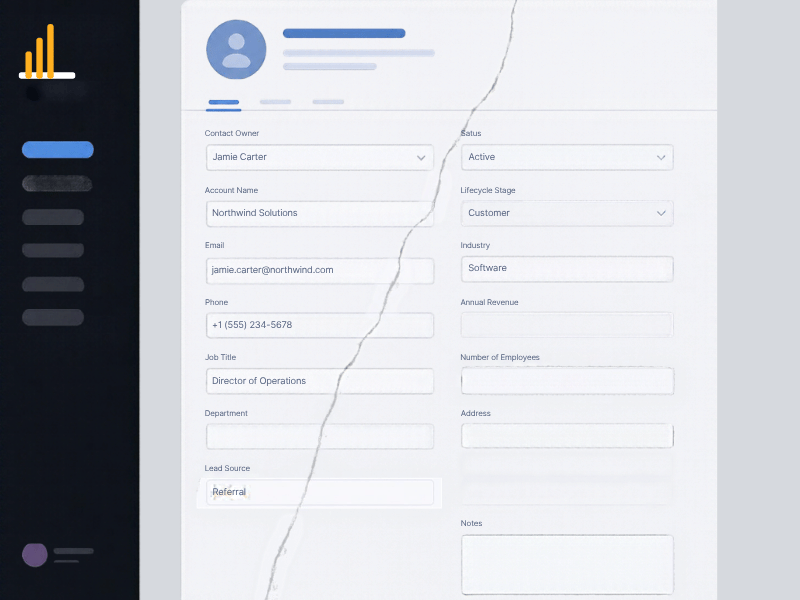
I've watched this exact pattern play out three times this year. A company rolls out an agent to auto-advance deals or trigger follow-up sequences based on pipeline stage. Two weeks later, the agent is doing precisely what it was told to do, and what it was told to do is garbage. Stage 3 means one thing to the rep who's been there five years and something completely different to the guy who started in March.
The agent didn't break the pipeline. It just moved faster through a process that was already broken, and now the breakage is visible to everyone, including the board.
AI Agents Don't Fix Bad Data, They Amplify It
Here's the thing nobody selling agent software wants to say out loud: automation is not a data hygiene shortcut. It's an amplifier. Feed it clean logic and you get speed. Feed it messy logic and you get chaos, just faster, with none of the human judgment that used to quietly catch the obvious mistakes.
I worked with a manufacturing distributor last year that rolled out an agent to auto-generate proposal emails once a deal hit stage 4, defined internally as verbal commitment received. Sounds precise enough. Except three of their five reps were marking deals as stage 4 the moment a prospect said something like that sounds good, let's talk next month. That's not a verbal commitment. That's a pleasantry.
The agent didn't know the difference. It fired proposal emails to prospects who hadn't agreed to anything, prospects got confused, one flagged it as spam-adjacent behavior, and the sales team spent two weeks doing damage control instead of selling. The agent worked exactly as configured. The configuration was built on stage definitions that five people would have described five different ways if anyone had bothered to ask them before launch.
This is the part that gets missed in every AI rollout deck: the tool is only as good as the definitions underneath it. If those definitions are fuzzy, you're not deploying automation, you're deploying a faster version of your own confusion.
The Five-Person Test Most Companies Skip
Before anyone connects an agent to your pipeline, sit five people down, ideally a mix of tenure and role, and ask them to define what stage 3 actually requires. Not describe it in general terms. Define it with the specificity you'd want written into a contract.
At a SaaS company I consulted with earlier this year, I ran exactly this exercise before they greenlit an agent-driven lead-routing project. Five people, one question: what does stage 3, qualified opportunity, actually require? I got five different answers. One rep said budget confirmed. Another said technical fit confirmed, budget optional. A third said the prospect had taken a second call. The VP of Sales said none of those, she said it meant the deal was in the CRM long enough that she felt comfortable forecasting against it, which isn't a qualification criterion at all, it's a vibe.
If you get five different answers to a question that should have one answer, you are not ready for automation. You're ready for a data model. That's not a knock on the team, it's just where they are. Most SMBs without a dedicated RevOps function have never had anyone force this conversation, because day to day, humans can paper over the ambiguity. An AI agent cannot. It executes the literal instruction, and if the instruction was built on five different mental models, you get five different outcomes colliding in your pipeline at once.
Stage Definitions Are a Governance Problem, Not a CRM Field
The instinct at most small and midsize companies is to treat this as a CRM configuration issue. Rename the fields, tighten up the picklist, add a required field before a rep can move a deal forward. That helps, but it's treating a symptom.
The actual problem is governance. Nobody owns the definition of what a stage means, and nobody has the authority to make it stick once it's decided. I've sat in plenty of pipeline reviews where a rep pushes a deal to stage 5 because it makes their forecast number look better that week, and nobody stops them because there's no agreed standard to point to, just a general sense that stage 5 means pretty far along.
A logistics company I worked with fixed this not by buying new software but by writing a one-page stage definition doc, plain language, one sentence per stage, with a required action tied to each one. Stage 3 required a signed discovery call summary logged in the CRM, not a checkbox, an actual document. It sounds almost too simple to matter, but it cut their stage-to-stage cycle time variance by nearly 40 percent within a quarter, because reps stopped guessing and stopped gaming the pipeline for optics. That documentation became the foundation they used before touching automation at all. Without it, any agent they layered on top would have just executed everyone's individual guesswork faster.
What To Fix Before You Buy the Agent
If you're evaluating agent tools this quarter, and most companies I talk to are, stop and ask yourself the honest question: is the blocker agent capability, or is it that nobody at your company has agreed on what your stages actually mean?
For most SMBs without dedicated RevOps, it's the second one, every time. The tools on the market right now are genuinely capable. That's not the gap. The gap is that they're being pointed at pipeline logic that was never rigorous to begin with, built by whoever set up the CRM three years ago and never revisited since.
Get the five-person answer first. Write down what each stage actually requires, tie it to a real action or artifact, not a feeling, and get your team enforcing it before an agent enforces it for you at a speed nobody can walk back. Automation doesn't forgive ambiguity, it just executes it faster.
If you're staring at a messy pipeline and wondering whether the problem is your tools or your definitions, that's exactly the kind of diagnostic work we do at LangLine Consulting. Reach out and we'll help you figure out which one it actually is before you spend money finding out the hard way.