The Real Forecast Lives in a Spreadsheet Nobody Told You About
Most CRMs stop being trustworthy long before leadership notices, so someone on the team quietly builds a spreadsheet to track what is actually happening. This post explains why that shadow tracker exists, what it costs your forecast accuracy, and how to fix the root problem instead of blaming the data.

The CRM you paid for isn't where your deals actually get managed. The spreadsheet your ops person built on a slow Tuesday afternoon is.
I have seen this exact setup was running quietly in the background. Leadership pulls the forecast from the CRM. The sales team pulls their actual next steps, real close dates, and honest probability from a Google Sheet that three or four people know about. Nobody approved this arrangement. Nobody put it in a process document. It happened because the CRM stopped reflecting reality and someone got tired of working around bad data every single day.
This is not a data hygiene problem you can clean your way out of. It is a trust problem, and trust problems in a CRM show up everywhere else too.
How the Shadow Spreadsheet Actually Gets Built
It rarely starts as a rebellion. It starts small. A sales rep gets asked in a pipeline review why a deal marked as 80 percent probability has gone quiet for three weeks. The honest answer is that the deal stalled after a budget conversation, but nobody updated the CRM because updating the CRM takes four extra clicks and the fields do not match how the deal actually progressed.
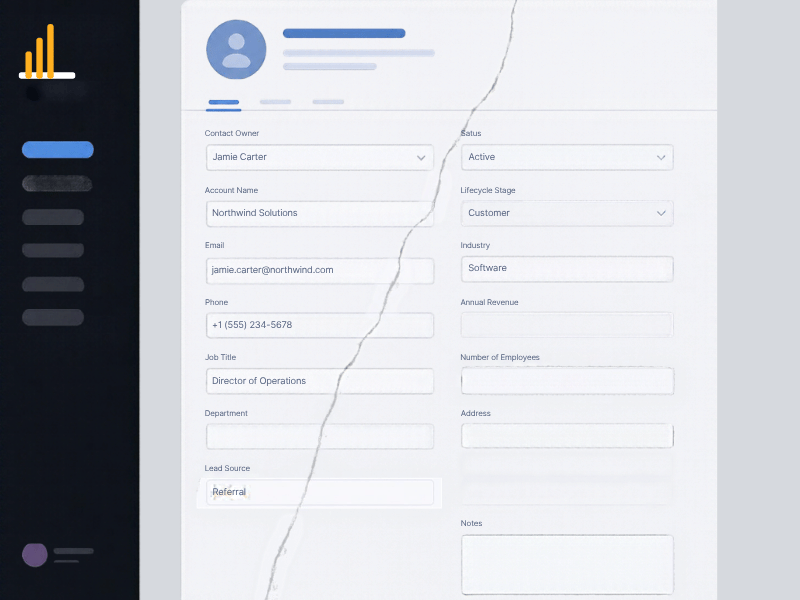
So the rep starts keeping their own notes. Maybe in a notebook at first, then in a personal spreadsheet, then that spreadsheet gets shared with their manager because the manager needs the real picture before a board meeting. Within two quarters, that spreadsheet has more accurate close dates, more accurate next steps, and a probability score that actually correlates with what closes.
Meanwhile the CRM still exists. People still update it, but only with whatever satisfies the minimum requirement to avoid getting flagged in a pipeline review. I worked with a company where this had been going on for over a year. The VP of Sales genuinely did not know a shadow tracker existed until I asked to see how deals moved from stage to stage and got a confused look followed by, oh, you probably want to see Denise's sheet.
Denise was an account executive. Denise's sheet was the real forecast.
Why This Wrecks Forecast Accuracy Specifically
Here is the part that costs real money. When leadership builds a quarterly forecast off CRM data that nobody trusts enough to keep current, the forecast is not just imprecise, it is systematically biased in a specific direction. Stale deals sit in the pipeline at inflated probability because nobody bothered to update or disqualify them. Meanwhile the deals that are actually progressing well often look understated in the CRM because the rep is tracking the real momentum somewhere else and only backfilling the CRM occasionally.
I have seen this produce forecasts that miss by 30 to 40 percent in either direction, not because the sales team is bad at selling, but because the system generating the number and the system reflecting reality are two different documents maintained by two different levels of diligence.
Another example, a manufacturing tech company, had a forecast that consistently overshot by roughly 25 percent every quarter for almost a year. The CFO assumed sales was sandbagging in reverse, being overly optimistic. What was actually happening was that reps were closing deals in a personal tracker, marking them won there, and then updating the CRM two or three weeks later during a slow moment. The CRM was always behind. The forecast built on it was always stale by definition, not by intent.
What to Actually Audit When the Forecast Keeps Missing
Most leaders respond to forecast misses by asking for a CRM data audit. Check the stage definitions, check the required fields, retrain the team on data entry. This treats the symptom.
The better first move is a five-minute conversation, not a data project. Ask each rep or account manager directly: where do you actually track your deals day to day. Not where are you supposed to track them, where do you actually go when you need to know what is real. If the answer is anywhere other than the CRM, you have found your forecast problem, and it has nothing to do with field mapping or pipeline stages.
At that manufacturing tech company, the fix was not a CRM overhaul. It was rebuilding two pipeline stages that did not match how deals actually progressed, removing a required field that nobody could answer honestly at the stage it was asked, and cutting the update cadence from mandatory daily entry to mandatory entry at each stage change. Within one quarter, the forecast miss dropped from 25 percent to under 8 percent. Nothing about the underlying sales process changed. The system just started matching how people actually worked instead of fighting it.
The Fix Is Rarely More Reporting
Small and midsize B2B companies without a dedicated RevOps function tend to solve forecast problems by adding more dashboards, more required fields, more mandatory updates. This almost always makes the shadow spreadsheet problem worse, not better, because it adds friction to a system people already avoid.
The actual fix is uncomfortable because it requires admitting the CRM setup does not match how deals really move through your org, and fixing that means sitting with a rep for an hour and mapping their real process against what the system currently forces them to do. It is not glamorous work. It is also the only work that actually closes the gap between the forecast leadership sees and the forecast that is true.
If your forecast keeps missing and you have already blamed the reps, the market, or the sales cycle, ask a different question first. Ask who on your team stopped trusting the system of record, and what they built instead to cope with it. That spreadsheet is not a rogue behavior problem. It is a diagnostic tool leadership never asked to see.
Where is the shadow spreadsheet in your organization right now, and does anyone above the individual contributor level know it exists? If you are not sure, that uncertainty is the answer.
If you want a second set of eyes on why your forecast keeps drifting and where the real process actually lives, LangLine Consulting spends its time exactly here, fixing the gap between the CRM you paid for and the process your team actually runs. Reach out and we can walk through what that would look like for your setup.